
Espectro solar: salida, puesta y clima espacial
Horario de eventos solares
| Puesta/Salida del Sol | 16:27 | 05:19 | ||||||
| Crepúsculo civil | 16:55 | 04:51 | ||||||
| Crepúsculo náutico | 17:25 | 04:21 | ||||||
| Noche astronómica | 17:55 | 03:51 |
| Elevación en el tránsito | 44° |
| Hora del tránsito | 10:53 |
| Distancia a la Tierra | 0,99684 ua (149,125,141 km) |
Sol
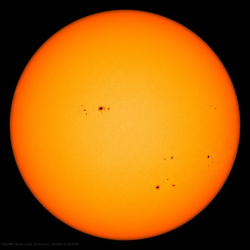 Última actualización: 16 de octubre de 2026 a las 19:00
Actividad actual de manchas y fulguraciones
Actualmente hay 133 regiones activas de manchas solares visibles desde la Tierra, con diferentes tamaños y complejidades magnéticas. No se detectaron regiones nuevas en las últimas 24 horas.La mayor mancha solar es AR 4551, de clase Eki, con un área de 620 millonésimas del hemisferio solar (MSH) y 32 manchas individuales.
Hoy no se detectaron fulguraciones significativas. Datos actualizados a 29 de junio de 2026 a las 05:01.
Imágenes solares en tiempo real
Los datos utilizados en estas imágenes proceden del Solar Dynamics Observatory (SDO), una misión de la NASA que estudia la variabilidad solar y sus efectos sobre la Tierra. Sus instrumentos AIA y HMI ofrecen imágenes en tiempo real y alta resolución en varias longitudes de onda para estudiar la actividad solar y el clima espacial. Agradecemos al equipo del SDO y a la NASA que estos datos sean públicos.
Magnetograma
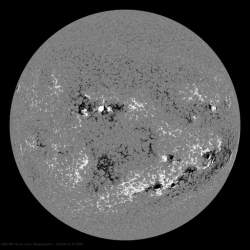
Los magnetogramas HMI muestran la intensidad y la dirección del campo magnético en la superficie solar. Las imágenes del instrumento HMI del Solar Dynamics Observatory (SDO) revelan estructuras magnéticas complejas, manchas solares y regiones activas.
Intensitograma
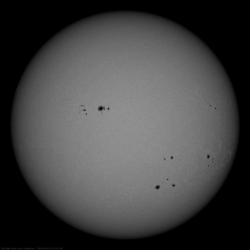
Los diagramas de intensidad HMI muestran la superficie solar en luz visible y destacan las manchas solares, la granulación y las fáculas. Permiten observar con detalle la fotosfera y seguir la evolución y el movimiento de las manchas.
Magnetismo solar: dinámica de los bucles coronales
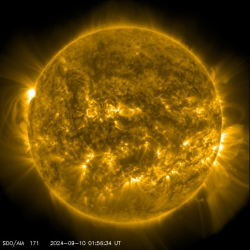
Estas imágenes a 171 Å resaltan la corona solar y la región de transición superior. Las imágenes AIA del Solar Dynamics Observatory (SDO) revelan la atmósfera exterior y sus líneas de campo magnético, especialmente los bucles de plasma a millones de grados.
Regiones activas, fulguraciones y agujeros coronales
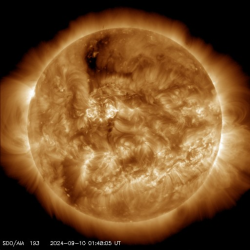
Las imágenes AIA a 193 Å muestran la corona caliente, las regiones activas, las fulguraciones y los agujeros coronales. Esta longitud de onda resulta especialmente útil para observar plasma a alta temperatura y las regiones de donde escapa el viento solar.
Recorrido del Sol durante el día
Haz doble clic para desbloquear el mapa.
Posición actual del Sol
| Hora | 19:45 |
| Latitud | 37.3541 |
| Longitud | -121.955 |
| Elevación | -39° |
| Acimut | 291° |
Dinámica anual de la luz solar
Propiedades del Sol
| Fecha | 17 de octubre de 2026 |
| Inicio del crepúsculo | 17:25 |
| Fin del crepúsculo | 04:21 |
| Duración de la sesión astronómica | 11h 56m |
| Elevación en el tránsito | 44° |
| Hora del tránsito | 10:53 |
| Distancia a la Tierra | 0,99684 ua (149,125,141 km) |
| Coordenadas ecuatoriales a medianoche | RA: 13h 28m 15s", Dec: -9° 15' 00s |
| Constelación | Virgo |
Último y próximo eclipse solar
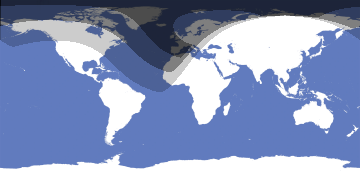
12 de agosto de 2026
Eclipse Solar Total
Global
100%
Local
-
| Global | Desde tu ubicación | |
|---|---|---|
| Penumbra | 06:36-10:58 | No visible |
| Umbra | 07:59-09:36 | No visible |
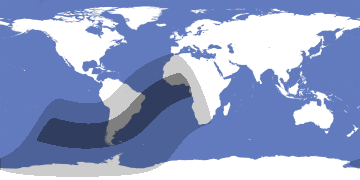
6 de febrero de 2027
Eclipse Solar Anular
Global
86%
Local
-
| Global | Desde tu ubicación | |
|---|---|---|
| Penumbra | 03:59-10:02 | No visible |
| Antumbra | 05:05-08:57 | No visible |
Último y próximo eclipse lunar
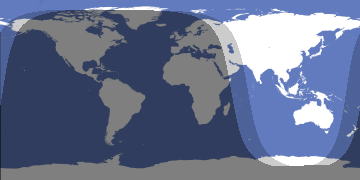
28 de agosto de 2026
Eclipse Lunar Parcial
Global
96,9%
Local
96,9%
| Global | Desde tu ubicación | ||
|---|---|---|---|
| Fase penumbral | 16:26-22:02 | 17:35-22:02 | |
| Fase parcial | 17:35-20:54 | 17:35-20:53 | |
| Fase total | - | - |
20 de febrero de 2027
Eclipse Lunar Penumbral
Global
96,4%
Local
-
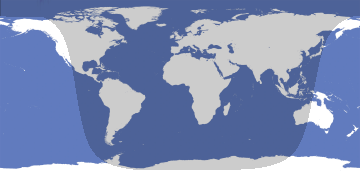
| Global | Desde tu ubicación | ||
|---|---|---|---|
| Fase penumbral | 12:14-16:14 | No visible | |
| Fase parcial | - | No visible | |
| Fase total | - | No visible |
Actividad de auroras
Norte
Sur
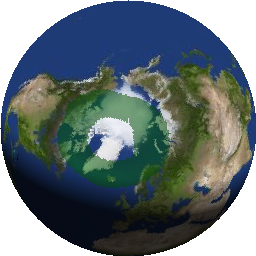
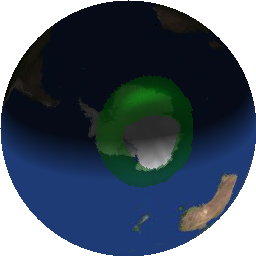
Índice Kp: . Actividad geomagnética muy tranquila
Probabilidad de aurora en tu ubicación: 0%
Parámetros astrométricos y físicos de Sol
Coordenadas y visibilidad
| Ascensión recta | 13h 28m 16s |
| Declinación | -9° 15′ 01″ |
| Magnitud | -26,7 |
| Constelación | Virgo |
| Elevación | -39,2° |
| Acimut | 291,2° |
Propiedades básicas
| Masa, kg | 1,98841E+30 |
| Densidad media, g/cm³ | 1,408 |
Rotación
| Período de rotación sideral, días | 25,38 |
Superficie y atmósfera
| Gravedad superficial, m/s² | 274,0 m/s^2 |
| Velocidad de escape, km/s | 617,7 |
| Temperatura media, K | 5772 |
Reconocimiento de datos
Los parámetros físicos y orbitales del sistema solar proceden de Solar System OpenData API mantenido por Le Système Solaire. Agradecemos a sus colaboradores que hagan públicos estos datos.