
Observation details: asteroid Laetitia
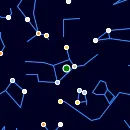
Daily motion of Laetitia
From your location, Laetitia is Visible from early morning until sunrise. Its current altitude, direction, rise and set times, and finder chart are shown below.39 Laetitia will remain visible until September 22, when it moves too close to the Sun and temporarily disappears from the night sky.
Laetitia visibility on 2026-11-27
Laetitia Visible from early morning until sunrise
Laetitia rise and set timetable
| Time | Elevation | |
| Laetitia transit | 08:40 | 87° |
| Laetitia set | 14:39 | |
| Astronomical observing session begins | 19:04 | -66° |
Moonrise, 97% illuminated  | 20:02 | -81° |
| Laetitia rise | 02:38 | |
| Astronomical observing session ends | 04:30 | 28° |
| Twilight end (−12°) | 04:56 | 35° |
| Civil sunrise | 05:21 | 41° |
| Sunrise | 05:45 | 47° |
| Moonset | 08:35 | 87° |
Track Laetitia position throughout the night
← 27 November 2026 →
| Time | |
| Altitude | |
| Azimuth |
Shift the map to change the time and observe Laetitia changing position in the night sky.
Laetitia Description
This asteroid is designated 39 Laetitia, main-belt asteroid Its diameter is approximately 180 km. 39 Laetitia completes an orbit around the Sun in 4.6 years. It is currently 3.633 AU (543,489,064 km) from Earth, and is located in the constellation Virgo.Current position in the Solar System: Laetitia
| Date | Fri, 27 November 2026 |
| Distance from Earth | 3.633 AU (543,489,064km) |
| Elongation | 49° |
| Angular diameter | " |
| Magnitude | 12.02 |
Finder Chart for Laetitia
Annual motion of Laetitia
| Date | Sat, 28 November 2026 |
| Twilight start | 19:02 |
| Twilight end | 04:25 |
| Twilight duration | 9h 24m |
| Rise | 02:34 |
| Set | 14:32 |
| Elevation at transit | 87° |
| Transit time | 08:33 |
| Equatorial coordinates | RA: 13h 02m 46s", Dec: -2° 41' 25s |
| Magnitude | 12 |
| Constellation | Virgo |
The graph summarizes the object’s annual visibility, daily observing windows and transit times.
The vertical axis shows time of day and the horizontal axis shows the days of the year.
The shaded area marks when the object is above the horizon; the white line marks daily transit. You can also view the detailed annual visibility table.
Astrometric and Physical Parameters of 39 Laetitia
Coordinates and Visibility
| Right Ascension | 13h 01m 33s |
| Declination | -2° 36′ 06″ |
| Magnitude | 12.02 |
| Constellation | Virgo |
| Elevation | -26.7° |
| Azimuth | 92.9° |
Acknowledgments
Orbital and small-body data are provided by NASA Jet Propulsion Laboratory (JPL) Small-Body Database (SBDB) and Center for Near-Earth Object Studies (CNEOS). These resources support accurate positions, orbits and physical characteristics.