Sky Tonight
ST
Location settings
Santa Clara, US
37.4°/-122°
GMT -9
Waning20:38 - 04:31
  ⌕
☾
☰
  • Tonight
    • Brightest Objects
  • Solar System
    • Sun
    • Moon
    • Planets
    • Mercury
    • Venus
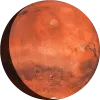
    • Mars
    • Jupiter
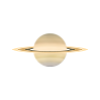
    • Saturn
    • Satellite Flyovers
    • ISS
    • Close Approaches
  • Small Bodies
    • Asteroids
    • Comets
  • Stars
    • Brightest Stars
  • Meteor Showers
    • Active Meteor Showers
    • Major Meteor Showers
  • Solar Eclipses
    • Future Solar Eclipses
    • Past Solar Eclipses
  • Lunar Eclipses
    • Future Lunar Eclipses
    • Past Lunar Eclipses
  • Deep Sky Objects
    • Spring Nebulae
    • Messier Objects
    • Nebulae
    • Star Clusters
    • Galaxies
  • Double Stars
    • Naked-Eye
    • Binocular
    • Physical
    • Color-Contrasting
    • Triple Star Systems
    • Multiple Star Systems
  • Constellations
    • Visible Tonight
    • Seasonal
    • Ecliptic
    • All 88 Constellations
  • Maps
    • Lunar map
    • Mars map
    • Mercury map
    • Earth
    • Cloud Cover Map
    • Aurora Activity
  • Contact Us
    • Feedback

Observation Settings

Or select it on the map:
This Earth map fragment is intended to illustrate celestial motion across the sky, emphasizing both bearing and elevational perspectives. The map's center point corresponds to the transit, showcasing celestial objects at their highest point, while elevation gradually decreases towards the map edges. This dynamic representation offers insights into the changing positions of celestial bodies with a focus on their bearing and elevational trajectories.
Your location: Santa Clara, United States
Timezone:
Latitude:
37.3541
Longitude:
-121.955

Sky Tonight

Whether you're using just your eyes, binoculars, or a telescope, the night sky offers endless wonders waiting to be discovered. Happy stargazing!

What’s Visible in the Sky Tonight — March 8-9

Sun

From your location, the Sun sets at 17:07, and nautical twilight ends at 18:04, leaving the night sky dark enough for stargazing until morning twilight begins at 04:31.

Moon

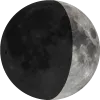
The Moon is a 3rd Quarter, about 70% illuminated. It rises at 21:48 and sets at 07:48.

Planets

Venus: visible in the evening sky. Jupiter: visible from sunset through most of the night.

Stars

Notable stars include Arcturus, Vega, and Capella, some of the brightest stars visible in the night sky.

Deep-Sky Objects

Tonight, several deep-sky objects are visible, including Beehive, , and , which can be seen with binoculars or a small telescope.

Sky Map

Celectial bearing and elevation at 20:38
The sky tonight looks different depending on where you are. This interactive sky map shows what’s visible right now from your location — including the Moon, planets, bright stars, meteor activity, satellite flyovers, and current observing conditions. Only the brightest and most noticeable objects are shown to help you quickly get oriented.
You can explore the sky by moving the map horizontally to see how the view changes as the night progresses.

Celestial Delights for Your Night Sky Adventure

Tonight's celestial wonders are ready to amaze and inspire. Here's a brief list of what you can explore:

Solar System Objects

Sun

Our Star

Sun
↗ 05:35 ↘ 17:01 ↑ -12°
☼ -26.8 ✣ 32'
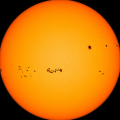
5 active sunspot regions. Largest: 4384 (Dao, 240 MSH). No significant flares detected today.
More about Sun

Moon

3rd Quarter (70%)

Moon
↗ 22:50 ↘ 08:23 ↑ 28°
☼ -10.8 ✣ 30'
The New Moon occurs on Wed, 18 March 2026 at 16:07 on Pisces
The Full Moon follows on Wed, 1 April 2026 at 16:44 on Virgo
More about Moon

Planets

See which planets are currently visible, along with their rise and set times, to help you plan your observations.

Venus

Visible in the evening sky

Venus
↗ 06:14 ↘ 18:15 ↑ 8°
☼ -3.9 ✣ 10.2"
Venus is currently in the constellation Pisces. It is now brightening after conjunction and will reach its next greatest elongation on 2026-08-16.
More about Venus

Jupiter

Visible from sunset through most of the night

Jupiter
↗ 11:51 ↘ 02:20 ↑ 65°
☼ -2.4 ✣ 41.8"
Jupiter is currently in the constellation Gemini. It is now fading as it moves toward conjunction, and will reach its next opposition on 2027-02-12.
More about Jupiter
For a comprehensive list of observable planets and dates for upcoming visibility, visit our Planets in the Sky Tonight page.

Satellite Flyovers

A short list of upcoming brightest satellite flyovers.
No bright satellite flyovers are expected in the next hour.
To view the complete list, visit our Satellites page.

Brightest Stars

Check out the five brightest stars currently visible in the night sky.

Arcturus

Star

Arcturus
↗ 20:38 ↘ 09:15 ↑ 72°
☼ -0.1 ✣ -
Arcturus, the fourth brightest star, is an orange giant in the constellation Boötes. Its distinctive hue and brightness make it easily recognizable in the night sky.
More about Arcturus

Vega

Star

Vega
↗ 22:05 ↘ 15:05 ↑ 66°
☼ 0 ✣ -
Vega, the fifth brightest star, is part of the constellation Lyra. It is one of the most luminous stars visible from Earth and a prominent member of the Summer Triangle asterism.
More about Vega

Capella

Star

Capella
↗ 20:38 ↘ 04:31 ↑ 52°
☼ 0.1 ✣ -
Capella, the sixth brightest star, is a yellow giant located in the constellation Auriga. Its brightness and close proximity to the celestial north pole make it easily identifiable.
More about Capella

Procyon

Star

Procyon
↗ 20:38 ↘ 04:31 ↑ 55°
☼ 0.4 ✣ -
Procyon, the eighth brightest star, is a binary system in the constellation Canis Minor. Its name means 'before the dog' as it rises just before Sirius, the 'Dog Star'.
More about Procyon

Betelgeuse

Star

Betelgeuse
↗ 20:38 ↘ 04:31 ↑ 42°
☼ 0.5 ✣ -
Betelgeuse, the tenth brightest star, is a red supergiant in the constellation Orion. It is one of the largest known stars and exhibits noticeable variability in brightness.
More about Betelgeuse
If you've enjoyed learning about these five stunning celestial wonders, don't miss out on exploring our list of the brightest stars in the night sky

Double Stars

Discover the brightest double stars currently visible in the night sky.

04287+1552

Multiple Star System

04287+1552
↗ 20:38 ↘ 04:31 ↑ 31°
☼ 3.74/3.94 ✣ 6'
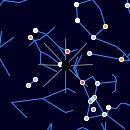
8-star star system in the constellation Taurus with primary and secondary components of magnitudes 3.74 and 3.94, separated by 5.7 arcminutes.
More about 04287+1552

05061+5858

Multiple Star System

05061+5858
↗ - ↘ - ↑ 50°
☼ 5.0/6.21 ✣ 3'
5-star star system in the constellation Camelopardalis with primary and secondary components of magnitudes 5.00 and 6.21, separated by 3 arcminutes.
More about 05061+5858

14509-1603

Multiple Star System

14509-1603
↗ 21:41 ↘ 07:58 ↑ 37°
☼ 3.3/5.19 ✣ 4'
8-star star system in the constellation Libra with primary and secondary components of magnitudes 3.30 and 5.19, separated by 3.8 arcminutes.
More about 14509-1603

04254+2218

Multiple Star System

04254+2218
↗ 20:38 ↘ 04:31 ↑ 34°
☼ 5.2/5.29 ✣ 6'
8-star star system in the constellation Taurus with primary and secondary components of magnitudes 5.20 and 5.29, separated by 5.7 arcminutes.
More about 04254+2218

10167+2325

Triple Star System

10167+2325
↗ 20:38 ↘ 05:32 ↑ 76°
☼ 3.46/6.03 ✣ 5'
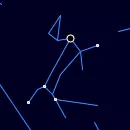
Triple star system in the constellation Leo with primary and secondary components of magnitudes 3.46 and 6.03, separated by 5.2 arcminutes.
More about 10167+2325

Nebulae

Discover the brightest nebulae currently visible in the night sky.

Beehive (M44)

Open Cluster

Beehive (M44)
↗ 20:38 ↘ 04:31 ↑ 72°
☼ 3.1 ✣ 2'
The Beehive Cluster, an open star cluster containing over 1,000 stars, located approximately 577 light-years away in the constellation Cancer.
More about Beehive (M44)

M47

Open Cluster

M47
↗ 20:38 ↘ 04:31 ↑ 36°
☼ 4.4 ✣ 19.80"
An open star cluster containing over 500 stars, located approximately 1,600 light-years away in the constellation Puppis.
More about M47

M39

Open Cluster

M39
↗ 20:38 ↘ 04:31 ↑ 36°
☼ 4.6 ✣ 19.50"
An open star cluster containing approximately 30 stars, located approximately 800 light-years away in the constellation Cygnus.
More about M39

M10

Globular Cluster

M10
↗ 23:09 ↘ 10:42 ↑ 48°
☼ 5 ✣ 9.30"
A globular cluster containing roughly 100,000 stars, located approximately 14,300 light-years away in the constellation Ophiuchus.
More about M10

M35

Open Cluster

M35
↗ 20:38 ↘ 04:31 ↑ 56°
☼ 5.1 ✣ 24.00"
An open star cluster containing over 1200 stars, located approximately 2,800 light-years away in the constellation Gemini.
More about M35
For a complete list of nebulae visible tonight, go to our Nebulae Page. There, you'll find detailed information on each nebula, including its location, brightness and photos.