Sky Tonight
ST
Location settings
Santa Clara, US
37.4°/-122°
GMT -9
Waning19:15 - 04:10
  ⌕
☾
☰
Sky-Tonight.com / Sun / SunSpots
  • Tonight
    • Brightest Objects
  • Solar System
    • Sun
    • Moon
    • Planets
    • Mercury
    • Venus
    • Mars
    • Jupiter
    • Saturn
    • Satellite Flyovers
    • ISS
    • Close Approaches
  • Small Bodies
    • Asteroids
    • Comets
  • Stars
    • Brightest Stars
  • Meteor Showers
    • Active Meteor Showers
    • Major Meteor Showers
  • Solar Eclipses
    • Future Solar Eclipses
    • Past Solar Eclipses
  • Lunar Eclipses
    • Future Lunar Eclipses
    • Past Lunar Eclipses
  • Deep Sky Objects
    • Spring Nebulae
    • Messier Objects
    • Nebulae
    • Star Clusters
    • Galaxies
  • Double Stars
    • Naked-Eye
    • Binocular
    • Physical
    • Color-Contrasting
    • Triple Star Systems
    • Multiple Star Systems
  • Constellations
    • Visible Tonight
    • Seasonal
    • Ecliptic
    • All 88 Constellations
  • Maps
    • Lunar map
    • Mars map
    • Mercury map
    • Earth
    • Cloud Cover Map
    • Aurora Activity
  • Contact Us
    • Feedback

Observation Settings

Or select it on the map:
This Earth map fragment is intended to illustrate celestial motion across the sky, emphasizing both bearing and elevational perspectives. The map's center point corresponds to the transit, showcasing celestial objects at their highest point, while elevation gradually decreases towards the map edges. This dynamic representation offers insights into the changing positions of celestial bodies with a focus on their bearing and elevational trajectories.
Your location: Santa Clara, United States
Timezone:
Latitude:
37.3541
Longitude:
-121.955

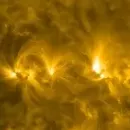
Real-Time Sun Map with Active Sunspots

Double-click to unlock the map
Selected map type: AIA 171 Å

Explore the Sun in real time using our interactive map, which displays the solar disk across multiple wavelengths — including visible light, ultraviolet, and magnetograms. Track active sunspot regions visually as they evolve on the surface of the Sun.

The map allows you to switch between different spectral views to observe magnetic activity, coronal structure, and sunspot positions in detail.

Below the map, you'll find a live list of all currently visible sunspots. Each entry includes the NOAA sunspot number, magnetic classification, flare risk, and physical properties such as area and spot count.

  • Interactive Solar Map: View the Sun in different wavelengths and follow active regions in real time
  • Sunspot Highlights: All visible sunspot regions are marked on the map
  • Detailed Sunspot List: Includes magnetic class, size (MSH), flare probabilities, and more

Both the map and the list are updated continuously using the latest observations from solar observatories.

Current Sunspot Regions

Below is a list of all sunspot regions currently visible on the solar disk. Each sunspot is an area of intense magnetic activity, often associated with solar flares and coronal mass ejections.

Every entry includes the NOAA active region number, magnetic classification, estimated area in millionths of the solar hemisphere (MSH), number of distinct spots, and flare probabilities. The list is continuously updated with the latest data from solar observatories.

4400

Sunspot Region
Spot count:
7
Area:
40
Coordinates:
S12W25
Class:
Dai
Magnetic Class:
BGD
AR 4400 is an Dai-class sunspot group that emerged on 2026-03-21 21:58. It covers 40 millionths of the solar disk and contains 7 individual spots.
View detailed sunspot info

4397

Sunspot Region

Spot count:
2
Area:
20
Coordinates:
N16E14
Class:
Cro
Magnetic Class:
B
AR 4397 is an Cro-class sunspot group that emerged on 2026-03-18 00:14. It covers 20 millionths of the solar disk and contains 2 individual spots.
View detailed sunspot info

4392

Sunspot Region

Spot count:
3
Area:
120
Coordinates:
S18W65
Class:
Cso
Magnetic Class:
B
M-Flares:
4
C-Flares:
1
AR 4392 is an Cso-class sunspot group that emerged on 2026-03-11 10:34. It covers 120 millionths of the solar disk and contains 3 individual spots.
View detailed sunspot info

4402

Sunspot Region

Spot count:
1
Area:
80
Coordinates:
N14E68
Class:
Hax
Magnetic Class:
A
AR 4402 is an Hax-class sunspot group that emerged on 2026-03-21 22:01. It covers 80 millionths of the solar disk and contains 1 spot.
View detailed sunspot info

4401

Sunspot Region

Spot count:
5
Area:
100
Coordinates:
N24E63
Class:
Dao
Magnetic Class:
B
AR 4401 is an Dao-class sunspot group that emerged on 2026-03-21 21:59. It covers 100 millionths of the solar disk and contains 5 individual spots.
View detailed sunspot info

4399

Sunspot Region

Spot count:
3
Area:
170
Coordinates:
S17E68
Class:
Hax
Magnetic Class:
A
AR 4399 is an Hax-class sunspot group that emerged on 2026-03-21 08:40. It covers 170 millionths of the solar disk and contains 3 individual spots.
View detailed sunspot info

4398

Sunspot Region

Spot count:
5
Area:
20
Coordinates:
S15E13
Class:
Cro
Magnetic Class:
B
AR 4398 is an Cro-class sunspot group that emerged on 2026-03-21 08:39. It covers 20 millionths of the solar disk and contains 5 individual spots.
View detailed sunspot info

Acknowledgements

We gratefully thank the teams behind the Solar Dynamics Observatory (SDO), including the HMI, AIA, and EVE instrument teams, for their continuous work in solar monitoring.

We also thank the National Aeronautics and Space Administration (NASA), the Goddard Space Flight Center (GSFC), and the National Oceanic and Atmospheric Administration (NOAA) for their contributions to solar science and public data access.

Additional event data is provided by NASA’s DONKI (Database of Notifications, Knowledge, Information), which offers alerts and detailed records of solar flares, CMEs, and geomagnetic storms.