
Observation details: asteroid Zelinda
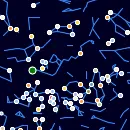
Daily motion of Zelinda
From your location, Zelinda is Visible from early morning until sunrise. Its current altitude, direction, rise and set times, and finder chart are shown below.654 Zelinda will become visible again around December 11 after moving far enough from the Sun.
Zelinda visibility on 2026-11-10
Zelinda Visible from early morning until sunrise
Zelinda rise and set timetable
| Time | Elevation | |
Moonrise, 0.7% illuminated  | 06:24 | 39° |
| Zelinda transit | 09:38 | 70° |
| Zelinda set | 15:37 | |
| Moonset | 18:49 | -45° |
| Astronomical observing session begins | 18:59 | -47° |
| Zelinda rise | 03:37 | |
| Astronomical observing session ends | 04:28 | 12° |
| Twilight end (−12°) | 04:53 | 18° |
| Civil sunrise | 05:18 | 24° |
| Sunrise | 05:41 | 29° |
Track Zelinda position throughout the night
← 10 November 2026 →
| Time | |
| Altitude | |
| Azimuth |
Shift the map to change the time and observe Zelinda changing position in the night sky.
Zelinda Description
This asteroid is designated 654 Zelinda, main-belt asteroid Its diameter is approximately 160 km. 654 Zelinda completes an orbit around the Sun in 3.5 years. It is currently 2.704 AU (404,512,642 km) from Earth, and is located in the constellation Corvus.Current position in the Solar System: Zelinda
| Date | Tue, 10 November 2026 |
| Distance from Earth | 2.703 AU (404,363,045km) |
| Elongation | 30° |
| Angular diameter | " |
| Magnitude | 13 |
Finder Chart for Zelinda
Annual motion of Zelinda
| Date | Wed, 11 November 2026 |
| Twilight start | 18:56 |
| Twilight end | 04:23 |
| Twilight duration | 9h 27m |
| Rise | 03:37 |
| Set | 15:35 |
| Elevation at transit | 70° |
| Transit time | 09:36 |
| Equatorial coordinates | RA: 12h 58m 15s", Dec: -19° 59' 48s |
| Magnitude | 13 |
| Constellation | Virgo |
The graph summarizes the object’s annual visibility, daily observing windows and transit times.
The vertical axis shows time of day and the horizontal axis shows the days of the year.
The shaded area marks when the object is above the horizon; the white line marks daily transit. You can also view the detailed annual visibility table.
Astrometric and Physical Parameters of 654 Zelinda
Coordinates and Visibility
| Right Ascension | 12h 56m 01s |
| Declination | -19° 44′ 15″ |
| Magnitude | 13 |
| Constellation | Corvus |
| Elevation | -6.7° |
| Azimuth | 250.1° |
Acknowledgments
Orbital and small-body data are provided by NASA Jet Propulsion Laboratory (JPL) Small-Body Database (SBDB) and Center for Near-Earth Object Studies (CNEOS). These resources support accurate positions, orbits and physical characteristics.