Sky Tonight
ST
Location settings
Santa Clara, US
37.4°/-122°
GMT -10
Waning16:36 - 04:07
🔎
☰
Sky-Tonight.com / Solar System / Close approaches / Close Approach of Mars and Jupiter
  • Tonight
    • Brightest Objects
  • Solar System
    • Sun
    • Moon
    • Planets
    • Mercury
    • Venus
    • Mars
    • Jupiter
    • Saturn
    • Satellite Flyovers
    • ISS
    • Close Approaches
  • Small Bodies
    • Asteroids
    • Comets
  • Stars
    • Brightest Stars
  • Meteor Showers
    • Active Meteor Showers
    • Major Meteor Showers
  • Solar Eclipses
    • Future Solar Eclipses
    • Past Solar Eclipses
  • Lunar Eclipses
    • Future Lunar Eclipses
    • Past Lunar Eclipses
  • Deep Sky Objects
    • Winter Nebulae
    • Messier Objects
    • Nebulae
    • Star Clusters
    • Galaxies
  • Double Stars
    • Naked-Eye
    • Binocular
    • Physical
    • Color-Contrasting
    • Triple Star Systems
    • Multiple Star Systems
  • Constellations
    • Visible Tonight
    • Seasonal
    • Ecliptic
    • All 88 Constellations
  • Maps
    • Lunar map
    • Mars map
    • Mercury map
    • Earth
    • Cloud Cover Map
    • Aurora Activity
  • Contact Us
    • Feedback

Observation Settings

Or select it on the map:
This Earth map fragment is intended to illustrate celestial motion across the sky, emphasizing both bearing and elevational perspectives. The map's center point corresponds to the transit, showcasing celestial objects at their highest point, while elevation gradually decreases towards the map edges. This dynamic representation offers insights into the changing positions of celestial bodies with a focus on their bearing and elevational trajectories.
Your location: Santa Clara, United States
Timezone:
Latitude:
37.3541
Longitude:
-121.955

Close Approach of Mars and Jupiter at Sun, 15 November 2026, 15:51

General information

Close Approach of Mars and Jupiter at Sun, 15 November 2026, 15:51
The closest separation between Mars and Jupiter will occur on Sun, 15 November 2026, 15:51, when they will be separated by roughly 1.193°. The close approach occurs while both objects are below the horizon and cannot be observed.

Visibility window

The close approach begins when their separation drops below 1.5°, around 14:00, and ends when their separation grows beyond 1.5°, around 14:00. Observers can see them in the sky during this interval.

Elevation & direction at closest approach

At the moment of closest approach, Mars and Jupiter will be approximately -39° above the horizon, in the North.

Constellation

At the time of the closest approach, both objects will be located in or near the constellation Leo, making it easier to locate them in the night sky.

Close Approch Dynamics

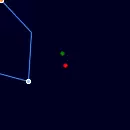
The map shows the event as it appears from your location. You can switch to Global view to see geocentric (Earth-centered) coordinates.
 

Close Approach Details

MarsJupiter
Time 15:51
Angular separation (°) 1.19
Geocentric Coordinates RA: 09h 54m 56s", Dec: 14° 44' 17s RA: 09h 53m 32s", Dec: 13° 35' 39s
Topocentric Coordinates RA: 09h 54m 56s", Dec: 14° 44' 12s RA: 09h 53m 32s", Dec: 13° 35' 38s
Distance 1.3067 AU (195,479,538 km) 5.2662 AU (787,812,307 km)
Angular Size 7.2" 37.4"
Altitude (°) -37 -39
Azimuth (°) 9 North 9 North

Track Mars and Jupiter Relative Positions

Elevation (degrees)
Time
Altitude
Azimuth
Shift the map to change the time and observe changing position in the night sky.