
Observation details: comet 49P/Arend-Rigaux
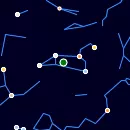
Daily motion of 49P/Arend-Rigaux
From your location, 49P/Arend-Rigaux is Visible from sunset until before midnight. Its current altitude, direction, rise and set times, and finder chart are shown below.90000580 49P/Arend-Rigaux will become visible again around January 18 after moving far enough from the Sun.
49P/Arend-Rigaux visibility on 2026-10-26
49P/Arend-Rigaux Visible from sunset until before midnight
49P/Arend-Rigaux rise and set timetable
| Time | Elevation | |
| 49P/Arend-Rigaux transit | 12:25 | 48° |
Moonrise, 99.8% illuminated  | 15:47 | 27° |
| Sunset | 16:16 | 22° |
| Civil sunset | 16:44 | 17° |
| Twilight start (−12°) | 17:14 | 11° |
| Astronomical observing session begins | 17:45 | 5° |
| 49P/Arend-Rigaux set | 18:10 | |
| Astronomical observing session ends | 03:59 | -31° |
| Moonset | 06:10 | -5° |
| 49P/Arend-Rigaux rise | 06:38 |
Track 49P/Arend-Rigaux position throughout the night
← 26 October 2026 →
| Time | |
| Altitude | |
| Azimuth |
Shift the map to change the time and observe 49P/Arend-Rigaux changing position in the night sky.
49P/Arend-Rigaux Description
This comet is designated 90000580 49P/Arend-Rigaux, Encke-type comet. 49P/Arend-Rigaux completes an orbit around the Sun in 6.7 years. It is currently 5.308 AU (794,110,377 km) from Earth, and is located in the constellation Libra.Current position in the Solar System: 49P/Arend-Rigaux
| Date | Mon, 26 October 2026 |
| Distance from Earth | AU (0km) |
| Elongation | 0° |
| Angular diameter | " |
| Magnitude |
Finder Chart for 49P/Arend-Rigaux
Annual motion of 49P/Arend-Rigaux
| Date | Mon, 26 October 2026 |
| Twilight start | 17:40 |
| Twilight end | 03:52 |
| Twilight duration | 10h 12m |
| Rise | 06:37 |
| Set | 18:06 |
| Elevation at transit | 48° |
| Transit time | 12:21 |
| Equatorial coordinates | RA: 15h 35m 04s", Dec: -4° 48' 02s |
| Magnitude | 22 |
| Constellation | Libra |
The graph summarizes the object’s annual visibility, daily observing windows and transit times.
The vertical axis shows time of day and the horizontal axis shows the days of the year.
The shaded area marks when the object is above the horizon; the white line marks daily transit. You can also view the detailed annual visibility table.
The vertical axis shows time of day and the horizontal axis shows the days of the year.
The shaded area marks when the object is above the horizon; the white line marks daily transit. You can also view the detailed annual visibility table.
Astrometric and Physical Parameters of 90000580 49P/Arend-Rigaux
Coordinates and Visibility
| Right Ascension | 15h 34m 09s |
| Declination | -4° 43′ 17″ |
| Magnitude | 21.7 |
| Constellation | Libra |
| Elevation | -12.4° |
| Azimuth | 86.5° |
Acknowledgments
Orbital and small-body data are provided by NASA Jet Propulsion Laboratory (JPL) Small-Body Database (SBDB) and Center for Near-Earth Object Studies (CNEOS). These resources support accurate positions, orbits and physical characteristics.