Sky Tonight
ST
Location settings
Santa Clara, US
37.4°/-122°
GMT -9
Waxing02:13 - 03:25
  ⌕
☾
☰
Sky-Tonight.com / Nebulae and Deep-Sky Objects / NGC1399
  • 🌐 EN
    ENES中文
  • Tonight
    • Brightest Planets and Stars Tonight
  • Solar System
    • Sun
    • Real-Time Sun Map
    • Sunspots Activity
    • Aurora Activity
    • Moon
    • Interactive Lunar Map
    • Planets
    • Mercury
    • Venus
    • Mars
    • Jupiter
    • Saturn
    • Satellite Flyovers
    • ISS
    • Close Approaches
  • Small Bodies
    • Asteroids
    • Comets
    • Recently Updated Comets
  • Stars
    • Brightest Stars
  • Meteor Showers
    • Active Meteor Showers
    • Major Meteor Showers
  • Solar Eclipses
    • Future Solar Eclipses
    • Past Solar Eclipses
  • Lunar Eclipses
    • Future Lunar Eclipses
    • Past Lunar Eclipses
  • Deep Sky Objects
    • Seasonal Nebulae
    • Messier Objects
    • Nebulae
    • Star Clusters
    • Galaxies
  • Double Stars
    • Naked-eye
    • Binocular
    • Physical pairs
    • Color-contrasting
    • Triple systems
    • Multiple systems
  • Constellations
    • Visible Tonight
    • Seasonal
    • Ecliptic
    • All 88 Constellations
  • Maps
    • Sky Map
    • Mars Map
    • Mercury Map
    • Earth
    • Cloud Cover Map
  • Contact Us
    • Feedback

Observation Settings

Or select it on the map:
This Earth map lets you select the observer’s location used to calculate the bearing and elevation of celestial objects. The selected point determines how the sky, rise and set times, and object positions are shown.
Your location: Santa Clara, United States
Timezone:
Latitude:
37.3541
Longitude:
-121.955

NGC1399 Position and Visibility Tonight
NGC1399

Where is NGC1399 right now?

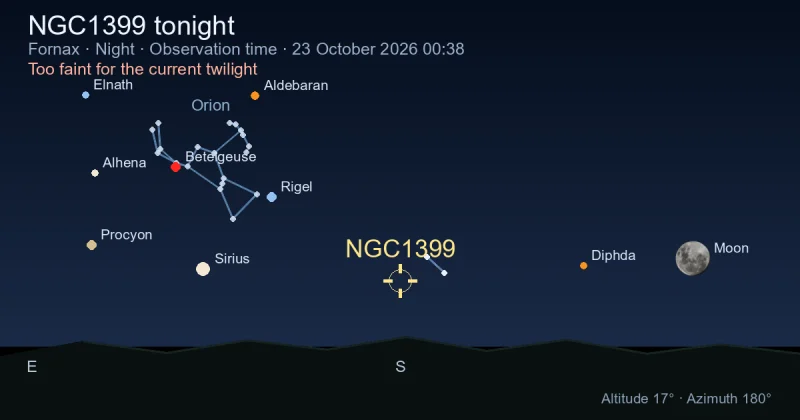
NGC1399 is located in the constellation Fornax. It is currently above the horizon at an altitude of 7° toward the south-east, with an apparent magnitude of 9.40.
Twilight begins at 02:13 local time. At that moment, NGC1399 will be 7° above the horizon toward the south-east.

NGC1399 visibility on 2026-08-17

NGC1399 Visible from early morning until before midnight

NGC1399 rise and set timetable

TimeElevation
Moonrise, 13.1% illuminated 08:461°
Astronomical observing session begins19:34-60°
Moonset19:59-55°
NGC1399 rise01:14
Astronomical observing session ends02:5011°
Twilight end03:2514°
Civil sunrise03:5816°
Sunrise04:2717°
NGC1399 transit05:0217°
NGC1399 set08:50

Track NGC1399 Position Throughout the Night

← 17 August 2026 →

Elevation (degrees)
Time
Altitude
Azimuth
Shift the map to change the time and observe NGC1399 changing position in the night sky.

NGC1399 — Image Gallery

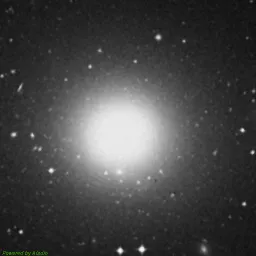
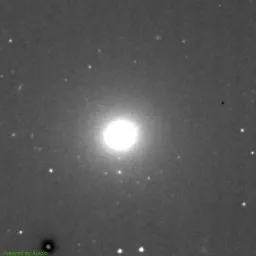
DSS Blue

NGC1399 — blue-filter image
Blue images highlight younger, hotter stars that emit strongly at blue wavelengths.

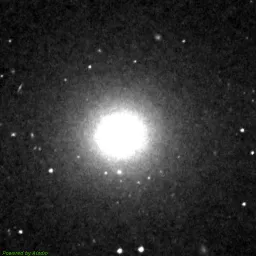
DSS Red

NGC1399 — red-filter image
Red images reveal older, cooler stars and emission nebulae glowing strongly in hydrogen-alpha light.

DSS Near-Infrared

NGC1399 — near-infrared image
Near-infrared images penetrate dust that obscures visible light and reveal hidden structures.

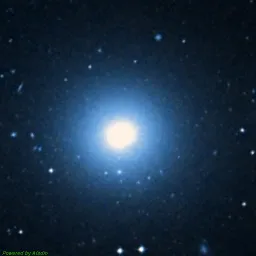
DSS Composite Image

NGC1399 — composite color image
DSS color images combine blue, red and often near-infrared exposures into a composite view.

The images come from the Digitized Sky Survey 2 (DSS2), produced at the Space Telescope Science Institute (STScI) under contract with NASA, using data from UK Science and Technology Facilities Council (STFC), European Southern Observatory (ESO), National Geographic Society-Palomar Observatory Sky Survey (POSS II).

Special thanks to National Optical Astronomy Observatory (NOAO), Royal Observatory, Edinburgh, California Institute of Technology for their significant contributions.

Finder Chart for NGC1399

Double-click to unlock the map.
Object nameNGC1399
Field of view
Limiting magnitude
NGC1399 coordinates3.6414, -35.45067
Center coordinates3.6414, -35.45067

NGC1399 Passage Through Night

Double-click to unlock the map.

Current position of NGC1399

Time02:13
Latitude37.3541
Longitude-121.955
Elevation7°
Azimuth146°
Here you can see the current position of NGC1399 on the map, as well as its positions for rise and set. This tool lets you track its movement throughout the night with accurate, up-to-date information.

Annual motion of NGC1399


NGC1399 will remain visible until March 25, when it moves too close to the Sun and temporarily disappears from the night sky.
Time
DateTue, 18 August 2026
Twilight start19:28
Twilight end02:44
Twilight duration7h 17m
Rise01:10
Set08:46
Elevation at transit17°
Transit time04:58
Equatorial coordinatesRA: 03h 38m 29s", Dec: -35° 27' 02s
Magnitude9
ConstellationFornax
The graph illustrates the annual visibility pattern of NGC1399, including its daily appearances and transit times. The vertical axis shows the hours of the day and the horizontal axis spans the year. The reddish area marks when the object is above the horizon, while the white line marks its daily transit.
You can also view detailed visibility information in a table with exact rise, transit, and set times for each date.

Astrometric and Physical Parameters of NGC1399

Coordinates and Visibility

Right Ascension3.6414°
Declination-35.45067°
Magnitude9.40
ConstellationFornax
Elevation7.2°
Azimuth146.4°

Data Credits

The deep-sky information on this page comes from the OpenNGC project developed by Matteo Verga. OpenNGC provides detailed catalog data for nebulae, galaxies, clusters and other deep-sky objects.

For details or contributions, visit the official repository: OpenNGC GitHub.