Sky Tonight
ST
Location settings
GPS 0°/0°
GMT +0
Waning20:09 - 04:53
⌕
Go to My SkyLog in
☾
☰
Sky-Tonight.com/NGC2089/How to find NGC2089 using Orion
  • 🌐 EN
    ENDEESFRPT中文
  • Tonight
    • Brightest Planets and Stars Tonight
    • Milky Way Tonight
  • Solar System
    • Sun
    • Real-Time Sun Map
    • Sunspots Activity
    • Aurora Activity
    • Moon
    • Interactive Lunar Map
    • Planets
    • Mercury
    • Venus
    • Mars
    • Jupiter
    • Saturn
    • Satellite Flyovers
    • ISS
    • Close Approaches
  • Small Bodies
    • Asteroids
    • Comets
    • Recently Updated Comets
  • Stars
    • Brightest Stars
  • Meteor Showers
    • Active Meteor Showers
    • Major Meteor Showers
  • Solar Eclipses
    • Future Solar Eclipses
    • Past Solar Eclipses
  • Lunar Eclipses
    • Future Lunar Eclipses
    • Past Lunar Eclipses
  • Deep Sky Objects
    • Seasonal Nebulae
    • Messier Objects
    • Nebulae
    • Star Clusters
    • Galaxies
  • Double Stars
    • Naked-eye
    • Binocular
    • Physical pairs
    • Color-contrasting
    • Triple systems
    • Multiple systems
  • Constellations
    • Visible Tonight
    • Seasonal
    • Ecliptic
    • All 88 Constellations
  • Maps
    • Sky Map
    • Printable Astronomy Maps & Star Charts
    • Mars Map
    • Mercury Map
    • Earth
    • Cloud Cover Map
  • Contact Us
    • Feedback

Observation Settings

Or select it on the map:
This Earth map lets you select the observer’s location used to calculate the bearing and elevation of celestial objects. The selected point determines how the sky, rise and set times, and object positions are shown.
Your location:
Timezone:
Latitude:
0
Longitude:
0

How to find NGC2089 using Orion

This guide uses bright stars first, then narrows the field for a telescope or binocular finder. Use Orion as the main sky landmark.

Follow the route from one recognizable star to the next until you reach NGC2089.

NGC2089 is 12° above the horizon toward the southeast.

View the current position and visibility tonight

Begin with Orion, then follow the reference stars toward NGC2089.

Orion

Recognize the characteristic star pattern of Orion before following the route.

Saiph

Identify Saiph in or near Orion; the chart shows its position relative to the guide.

HYG 27288.0

From Saiph, move about 5.2° toward the south until you reach HYG 27288.0.
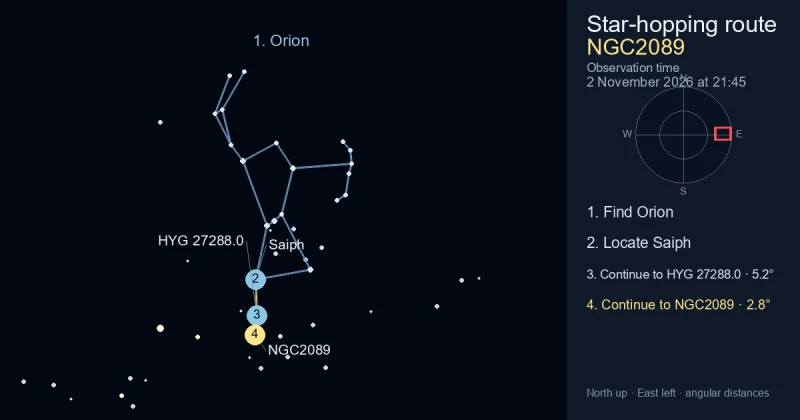
NGC2089

From HYG 27288.0, move about 2.8° toward the south until you reach NGC2089. This is the target field.

How to find NGC2089 using Orion

Finder Chart for NGC2089

Field of view 5.0°

Loading finder chart…
Loading interactive map…

View on Sky Map

More about NGC2089

  • NGC2089 Position and Visibility Tonight
  • Where is NGC2089 right now?