Sky Tonight
ST
Location settings
GPS 0°/0°
GMT +0
Waning18:38 - 04:56
⌕
Go to My SkyLog in
☾
☰
Sky-Tonight.com/Nebulae and Deep-Sky Objects/NGC2217
  • 🌐 EN
    ENDEESFRPT中文
  • Tonight
    • Brightest Planets and Stars Tonight
    • Milky Way Tonight
  • Solar System
    • Sun
    • Real-Time Sun Map
    • Sunspots Activity
    • Aurora Activity
    • Moon
    • Interactive Lunar Map
    • Planets
    • Mercury
    • Venus
    • Mars
    • Jupiter
    • Saturn
    • Satellite Flyovers
    • ISS
    • Close Approaches
  • Small Bodies
    • Asteroids
    • Comets
    • Recently Updated Comets
  • Stars
    • Brightest Stars
  • Meteor Showers
    • Active Meteor Showers
    • Major Meteor Showers
  • Solar Eclipses
    • Future Solar Eclipses
    • Past Solar Eclipses
  • Lunar Eclipses
    • Future Lunar Eclipses
    • Past Lunar Eclipses
  • Deep Sky Objects
    • Seasonal Nebulae
    • Messier Objects
    • Nebulae
    • Star Clusters
    • Galaxies
  • Double Stars
    • Naked-eye
    • Binocular
    • Physical pairs
    • Color-contrasting
    • Triple systems
    • Multiple systems
  • Constellations
    • Visible Tonight
    • Seasonal
    • Ecliptic
    • All 88 Constellations
  • Maps
    • Sky Map
    • Printable Astronomy Maps & Star Charts
    • Mars Map
    • Mercury Map
    • Earth
    • Cloud Cover Map
  • Contact Us
    • Feedback

Observation Settings

Or select it on the map:
This Earth map lets you select the observer’s location used to calculate the bearing and elevation of celestial objects. The selected point determines how the sky, rise and set times, and object positions are shown.
Your location:
Timezone:
Latitude:
0
Longitude:
0

NGC2217 Position and Visibility Tonight
NGC2217

Where is NGC2217 right now?

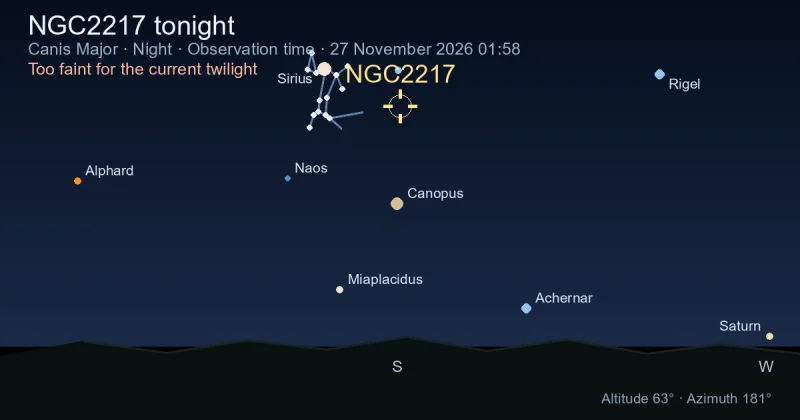
NGC2217 is located in the constellation Canis Major. It is currently below the horizon and is not visible from your location.
Open the interactive guide to NGC2217’s position and path tonight

NGC2217 tonight

NGC2217 tonight

NGC2217 visibility on 2026-11-26

NGC2217 Visible from before midnight until sunrise

NGC2217 rise and set timetable

TimeElevation
Astronomical observing session begins19:04-12°
NGC2217 rise19:58
Moonrise, 97% illuminated 20:021°
NGC2217 transit01:5763°
Astronomical observing session ends04:3044°
Twilight end (−12°)04:5639°
Civil sunrise05:2134°
Sunrise05:4529°
NGC2217 set07:56
Moonset08:35-9°

Track NGC2217 position throughout the night

← 26 November 2026 →

Elevation (degrees)
Time
Altitude
Azimuth
Shift the map to change the time and observe NGC2217 changing position in the night sky.

NGC2217 — Image Gallery

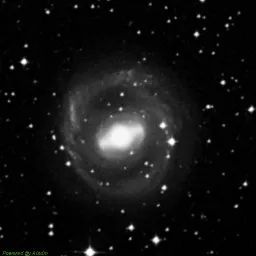
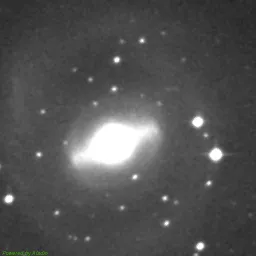
DSS Blue

NGC2217 — blue-filter image
Blue images highlight younger, hotter stars that emit strongly at blue wavelengths.

DSS Red

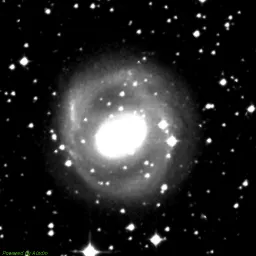
NGC2217 — red-filter image
Red images reveal older, cooler stars and emission nebulae glowing strongly in hydrogen-alpha light.

DSS Near-Infrared

NGC2217 — near-infrared image
Near-infrared images penetrate dust that obscures visible light and reveal hidden structures.

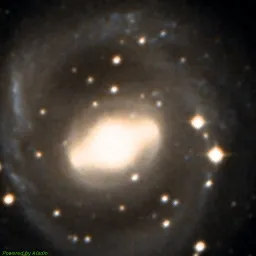
DSS Composite Image

NGC2217 — composite color image
DSS color images combine blue, red and often near-infrared exposures into a composite view.

The images come from the Digitized Sky Survey 2 (DSS2), produced at the Space Telescope Science Institute (STScI) under contract with NASA, using data from UK Science and Technology Facilities Council (STFC), European Southern Observatory (ESO), National Geographic Society-Palomar Observatory Sky Survey (POSS II).

Special thanks to National Optical Astronomy Observatory (NOAO), Royal Observatory, Edinburgh, California Institute of Technology for their significant contributions.

Finder Chart for NGC2217

Field of view 5.0°

Loading finder chart…
Loading interactive map…

Open the step-by-step guide View on Sky Map

NGC2217 Passage Through Night

Double-click to unlock the map.

Current position of NGC2217

Time15:57
Latitude0
Longitude0
Elevation-51°
Azimuth136°
Here you can see the current position of NGC2217 on the map, as well as its positions for rise and set. This tool lets you track its movement throughout the night with accurate, up-to-date information.

When Is NGC2217 Visible Throughout the Year?

NGC2217 will remain visible until May 12, when it moves too close to the Sun and temporarily disappears from the night sky. Time
DateFri, 27 November 2026
Astronomical observing session begins19:01
Astronomical observing session ends04:25
Astronomical observing duration9h 24m
Rise19:54
Set07:52
Elevation at transit63°
Transit time01:53
Equatorial coordinatesRA: 06h 21m 39s", Dec: -27° 14' 01s
Magnitude11
ConstellationCanis Major
The graph illustrates the annual visibility pattern of NGC2217, including its daily appearances and transit times. The vertical axis shows the hours of the day and the horizontal axis spans the year. The reddish area marks when the object is above the horizon, while the white line marks its daily transit.
You can also see when NGC2217 is visible throughout the year in a table with exact rise, transit, and set times for each date.

Astrometric and Physical Parameters of NGC2217

Coordinates and Visibility

Right Ascension06h 21m 40s
Declination-27° 14′ 02″
Magnitude10.57
ConstellationCanis Major
Elevation-50.7°
Azimuth136.2°

More about NGC2217

  • Where is NGC2217 right now?
  • How to find NGC2217

Data Credits

The deep-sky information on this page comes from the OpenNGC project developed by Matteo Verga. OpenNGC provides detailed catalog data for nebulae, galaxies, clusters and other deep-sky objects.

For details or contributions, visit the official repository: OpenNGC GitHub.