
Close Approaches of Mars
Close approaches visible from your location
Mars near Moon — closest 3°
30 November 2026 at 16:54
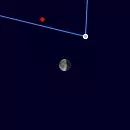
The closest separation between Mars and Moon will occur on 30 November 2026 at 16:54, when they will be separated by roughly 3°. At closest approach: The event occurs during daylight, making observation difficult. An observing opportunity within the separation window: 1 December 2026 at 00:09, separation about 5.5°.
Mars near Moon — closest 5.75°
24 January 2027 at 22:48
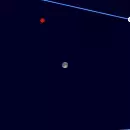
The closest separation between Mars and Moon will occur on 24 January 2027 at 22:48, when they will be separated by roughly 5.75°. At closest approach: Both objects will be above the horizon and can be observed.
Mars near Moon — closest 5.33°
20 February 2027 at 19:44
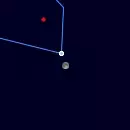
The closest separation between Mars and Moon will occur on 20 February 2027 at 19:44, when they will be separated by roughly 5.33°. At closest approach: Both objects will be above the horizon and can be observed.
Mars near Moon — closest 2.98°
15 April 2027 at 22:44
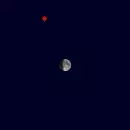
The closest separation between Mars and Moon will occur on 15 April 2027 at 22:44, when they will be separated by roughly 2.98°. At closest approach: Both objects will be above the horizon and can be observed.
Mars near Moon — closest 2.98°
13 May 2027 at 17:06
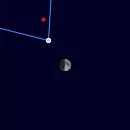
The closest separation between Mars and Moon will occur on 13 May 2027 at 17:06, when they will be separated by roughly 2.98°. At closest approach: The event occurs during daylight, making observation difficult. An observing opportunity within the separation window: 13 May 2027 at 18:25, separation about 2.9°.
Mars near Moon — closest 3.52°
10 June 2027 at 19:33
The closest separation between Mars and Moon will occur on 10 June 2027 at 19:33, when they will be separated by roughly 3.52°. At closest approach: Both objects will be above the horizon and can be observed.
Mars near Moon — closest 4.73°
6 August 2027 at 17:09
The closest separation between Mars and Moon will occur on 6 August 2027 at 17:09, when they will be separated by roughly 4.73°. At closest approach: The event occurs during daylight, making observation difficult. An observing opportunity within the separation window: 6 August 2027 at 18:32, separation about 5.1°.
Mars near Venus — closest 0.31°
25 November 2027 at 00:38
The closest separation between Mars and Venus will occur on 25 November 2027 at 00:38, when they will be separated by roughly 0.31°. At closest approach: Both objects will be below the horizon and cannot be observed. An observing opportunity within the separation window: 24 November 2027 at 19:30, separation about 0.3°.
Close approaches not visible from your location
Mars near Moon — closest 3.74°
9 July 2027 at 00:34
Not visible from your location
Begin (6°):July 8
20:24
End (6°)July 9
11:41
Elevation-32°
Separation3.74°
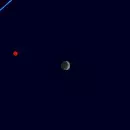
The closest separation between Mars and Moon will occur on 9 July 2027 at 00:34, when they will be separated by roughly 3.74°. At closest approach: Both objects will be below the horizon and cannot be observed.
Mars near Moon — closest 4.84°
4 September 2027 at 10:19
Not visible from your location
Begin (6°):03:47
End (6°)16:52
Elevation20°
Separation4.84°
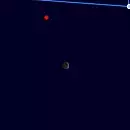
The closest separation between Mars and Moon will occur on 4 September 2027 at 10:19, when they will be separated by roughly 4.84°. At closest approach: The event occurs during daylight, making observation difficult.
Mars near Moon — closest 4.36°
3 October 2027 at 06:52
Not visible from your location
Begin (6°):October 2
23:05
End (6°)October 3
14:45
Elevation-21°
Separation4.36°
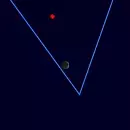
The closest separation between Mars and Moon will occur on 3 October 2027 at 06:52, when they will be separated by roughly 4.36°. At closest approach: The event occurs during daylight, making observation difficult.
Mars near Moon — closest 3.24°
1 November 2027 at 06:22
Not visible from your location
Begin (6°):October 31
20:26
End (6°)November 1
16:25
Elevation-21°
Separation3.24°
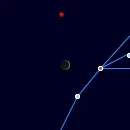
The closest separation between Mars and Moon will occur on 1 November 2027 at 06:22, when they will be separated by roughly 3.24°. At closest approach: The event occurs during daylight, making observation difficult.