Sky Tonight
ST
Location settings
GPS 0°/0°
GMT +0
Waning18:38 - 04:56
⌕
Go to My SkyLog in
☾
☰
Sky-Tonight.com/Solar System/Close Approaches/Close approach of Mars and Venus
  • 🌐 EN
    ENDEESFRPT中文
  • Tonight
    • Brightest Planets and Stars Tonight
    • Milky Way Tonight
  • Solar System
    • Sun
    • Real-Time Sun Map
    • Sunspots Activity
    • Aurora Activity
    • Moon
    • Interactive Lunar Map
    • Planets
    • Mercury
    • Venus
    • Mars
    • Jupiter
    • Saturn
    • Satellite Flyovers
    • ISS
    • Close Approaches
  • Small Bodies
    • Asteroids
    • Comets
    • Recently Updated Comets
  • Stars
    • Brightest Stars
  • Meteor Showers
    • Active Meteor Showers
    • Major Meteor Showers
  • Solar Eclipses
    • Future Solar Eclipses
    • Past Solar Eclipses
  • Lunar Eclipses
    • Future Lunar Eclipses
    • Past Lunar Eclipses
  • Deep Sky Objects
    • Seasonal Nebulae
    • Messier Objects
    • Nebulae
    • Star Clusters
    • Galaxies
  • Double Stars
    • Naked-eye
    • Binocular
    • Physical pairs
    • Color-contrasting
    • Triple systems
    • Multiple systems
  • Constellations
    • Visible Tonight
    • Seasonal
    • Ecliptic
    • All 88 Constellations
  • Maps
    • Sky Map
    • Printable Astronomy Maps & Star Charts
    • Mars Map
    • Mercury Map
    • Earth
    • Cloud Cover Map
  • Contact Us
    • Feedback

Observation Settings

Or select it on the map:
This Earth map lets you select the observer’s location used to calculate the bearing and elevation of celestial objects. The selected point determines how the sky, rise and set times, and object positions are shown.
Your location:
Timezone:
Latitude:
0
Longitude:
0

Close approach of Mars and Venus on 25 November 2027 at 00:38

General information
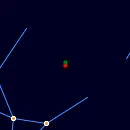
Close approach of Mars / Venus — 25 November 2027 at 00:38
The closest separation between Mars and Venus will occur on 25 November 2027 at 00:38, when they will be separated by roughly 0.31°. At closest approach: Both objects will be below the horizon and cannot be observed. An observing opportunity within the separation window: 24 November 2027 at 19:30, separation about 0.3°.

Visibility window

The event begins when the separation drops below 3° at about 24 November 2027 at 00:00, and ends when it grows beyond 3° at about 27 November 2027 at 00:00. The objects can be followed during this interval when observing conditions permit.

Elevation and direction at closest approach

At closest approach, Mars and Venus will be approximately -61° above the horizon toward the south-west.

Constellation

Both objects will be located in or near the constellation Sagittarius. This can help you locate them in the sky.

Track Mars / Venus relative positions

Elevation (degrees)
Time1827103080
Altitude
Azimuth
Move the map to change the time and follow how the objects change position in the sky.

Close approach dynamics

The map shows the event from your location. Switch to global view for geocentric (Earth-centered) coordinates.
 

Close approach details

MarsVenus
Time 00:38
Angular separation (°) 0.31
Geocentric coordinates RA: 17h 57m 30s", Dec: -24° 26' 10s RA: 17h 57m 25s", Dec: -24° 44' 43s
Topocentric coordinates RA: 17h 57m 30s", Dec: -24° 26' 09s RA: 17h 57m 24s", Dec: -24° 44' 40s
Distance 2.2306 AU (333,693,010 km) 1.4547 AU (217,620,023 km)
Angular size 4.2" 11.5"
Altitude (°) -61 -61
Azimuth (°) 211 Southwest 211 Southwest

More about Mars

  • Mars Position and Visibility Tonight
  • Where is Mars right now?
  • How to find Mars
  • How Mars’s apparent size changes
  • When Is Mars Visible Throughout the Year?

More about Venus

  • Venus Position and Visibility Tonight
  • Where is Venus right now?
  • How to find Venus
  • How Venus’s apparent size changes
  • When Is Venus Visible Throughout the Year?