
Close Approaches of Saturn
Close approaches visible from your location
Saturn near Moon — closest 6.06°
20 November 2026 at 20:06
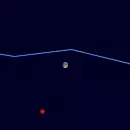
The closest separation between Saturn and Moon will occur on 20 November 2026 at 20:06, when they will be separated by roughly 6.06°. At closest approach: Both objects will be above the horizon and can be observed.
Saturn near Moon — closest 6.17°
18 December 2026 at 04:39
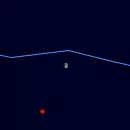
The closest separation between Saturn and Moon will occur on 18 December 2026 at 04:39, when they will be separated by roughly 6.17°. At closest approach: Both objects will be below the horizon and cannot be observed. An observing opportunity within the separation window: 18 December 2026 at 00:13, separation about 7.4°.
Saturn near Moon — closest 6.31°
14 January 2027 at 13:31
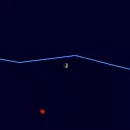
The closest separation between Saturn and Moon will occur on 14 January 2027 at 13:31, when they will be separated by roughly 6.31°. At closest approach: The event occurs during daylight, making observation difficult. An observing opportunity within the separation window: 14 January 2027 at 18:42, separation about 7°.
Saturn near Moon — closest 6.4°
10 February 2027 at 23:15
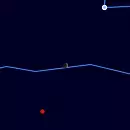
The closest separation between Saturn and Moon will occur on 10 February 2027 at 23:15, when they will be separated by roughly 6.4°. At closest approach: Both objects will be below the horizon and cannot be observed. An observing opportunity within the separation window: 10 February 2027 at 20:36, separation about 7.2°.
Saturn near Moon — closest 6.46°
10 March 2027 at 10:44
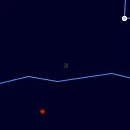
The closest separation between Saturn and Moon will occur on 10 March 2027 at 10:44, when they will be separated by roughly 6.46°. At closest approach: The event occurs during daylight, making observation difficult. An observing opportunity within the separation window: 10 March 2027 at 18:55, separation about 7.8°.
Venus near Saturn — closest 0.61°
7 May 2027 at 18:46
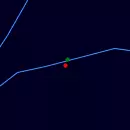
The closest separation between Venus and Saturn will occur on 7 May 2027 at 18:46, when they will be separated by roughly 0.61°. At closest approach: Both objects will be below the horizon and cannot be observed. An observing opportunity within the separation window: 8 May 2027 at 04:30, separation about 0.8°.
Saturn near Moon — closest 7.09°
1 June 2027 at 06:39
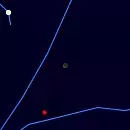
The closest separation between Saturn and Moon will occur on 1 June 2027 at 06:39, when they will be separated by roughly 7.09°. At closest approach: The event occurs during daylight, making observation difficult. An observing opportunity within the separation window: 1 June 2027 at 03:25, separation about 6.8°.
Saturn near Moon — closest 7.66°
26 July 2027 at 05:51
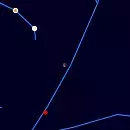
The closest separation between Saturn and Moon will occur on 26 July 2027 at 05:51, when they will be separated by roughly 7.66°. At closest approach: The event occurs during daylight, making observation difficult. An observing opportunity within the separation window: 26 July 2027 at 01:32, separation about 7.6°.
Saturn near Moon — closest 7.65°
15 October 2027 at 18:20
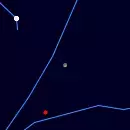
The closest separation between Saturn and Moon will occur on 15 October 2027 at 18:20, when they will be separated by roughly 7.65°. At closest approach: Both objects will be above the horizon and can be observed.
Close approaches not visible from your location
Saturn near Moon — closest 6.78°
4 May 2027 at 15:33
Not visible from your location
Begin (8°):07:51
End (8°)23:11
Elevation12°
Separation6.78°
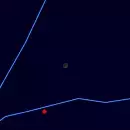
The closest separation between Saturn and Moon will occur on 4 May 2027 at 15:33, when they will be separated by roughly 6.78°. At closest approach: The event occurs during daylight, making observation difficult.
Saturn near Moon — closest 7.42°
28 June 2027 at 19:56
Not visible from your location
Begin (8°):June 28
14:24
14:24
End (8°)June 29
01:24
01:24
Elevation-70°
Separation7.42°
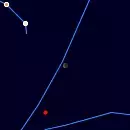
The closest separation between Saturn and Moon will occur on 28 June 2027 at 19:56, when they will be separated by roughly 7.42°. At closest approach: Both objects will be below the horizon and cannot be observed.
Saturn near Moon — closest 7.76°
22 August 2027 at 11:58
Not visible from your location
Begin (8°):08:16
End (8°)15:39
Elevation-35°
Separation7.76°
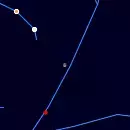
The closest separation between Saturn and Moon will occur on 22 August 2027 at 11:58, when they will be separated by roughly 7.76°. At closest approach: The event occurs during daylight, making observation difficult.
Saturn near Moon — closest 7.73°
18 September 2027 at 15:21
Not visible from your location
Begin (8°):11:27
End (8°)19:15
Elevation-61°
Separation7.73°
The closest separation between Saturn and Moon will occur on 18 September 2027 at 15:21, when they will be separated by roughly 7.73°. At closest approach: The event occurs during daylight, making observation difficult.