Sky Tonight
ST
Location settings
Santa Clara, US
37.4°/-122°
GMT -9
Waxing20:56 - 04:21
⌕
Go to My SkyLog in
☾
☰
Sky-Tonight.com / Solar System / Close Approaches / Close approach of Saturn and Moon
  • 🌐 EN
    ENDEESFRPT中文
  • Tonight
    • Brightest Planets and Stars Tonight
    • Milky Way Tonight
  • Solar System
    • Sun
    • Real-Time Sun Map
    • Sunspots Activity
    • Aurora Activity
    • Moon
    • Interactive Lunar Map
    • Planets
    • Mercury
    • Venus
    • Mars
    • Jupiter
    • Saturn
    • Satellite Flyovers
    • ISS
    • Close Approaches
  • Small Bodies
    • Asteroids
    • Comets
    • Recently Updated Comets
  • Stars
    • Brightest Stars
  • Meteor Showers
    • Active Meteor Showers
    • Major Meteor Showers
  • Solar Eclipses
    • Future Solar Eclipses
    • Past Solar Eclipses
  • Lunar Eclipses
    • Future Lunar Eclipses
    • Past Lunar Eclipses
  • Deep Sky Objects
    • Seasonal Nebulae
    • Messier Objects
    • Nebulae
    • Star Clusters
    • Galaxies
  • Double Stars
    • Naked-eye
    • Binocular
    • Physical pairs
    • Color-contrasting
    • Triple systems
    • Multiple systems
  • Constellations
    • Visible Tonight
    • Seasonal
    • Ecliptic
    • All 88 Constellations
  • Maps
    • Mars Map
    • Mercury Map
    • Earth
    • Cloud Cover Map
  • Contact Us
    • Feedback

Observation Settings

Or select it on the map:
This Earth map lets you select the observer’s location used to calculate the bearing and elevation of celestial objects. The selected point determines how the sky, rise and set times, and object positions are shown.
Your location: Santa Clara, United States
Timezone:
Latitude:
37.3541
Longitude:
-121.955

Close approach of Saturn and Moon on 15 October 2027 at 09:20

General information
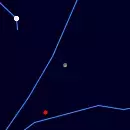
Close approach of Saturn / Moon — 15 October 2027 at 09:20
The closest separation between Saturn and Moon will occur on 15 October 2027 at 09:20, when they will be separated by roughly 7.654°. The event occurs during daylight, making observation difficult.

Visibility window

The event begins when the separation drops below 8° at about 05:01, and ends when it grows beyond 8° at about 13:38. The objects can be followed during this interval when observing conditions permit.

Elevation and direction at closest approach

At closest approach, Saturn and Moon will be approximately -34° above the horizon toward the north-west.

Constellation

Both objects will be located in or near the constellation Pisces. This can help you locate them in the sky.

Track Saturn / Moon relative positions

Elevation (degrees)
Time1823624400
Altitude
Azimuth
Move the map to change the time and follow how the objects change position in the sky.

Close approach dynamics

The map shows the event from your location. Switch to global view for geocentric (Earth-centered) coordinates.
 

Close approach details

SaturnMoon
Time 09:20
Angular separation (°) 7.65
Geocentric coordinates RA: 01h 35m 13s", Dec: 06° 56' 11s RA: 01h 23m 08s", Dec: 13° 59' 33s
Topocentric coordinates RA: 01h 35m 13s", Dec: 06° 56' 11s RA: 01h 21m 55s", Dec: 13° 16' 50s
Distance 8.3268 AU (1,245,671,550 km) 0.0026 AU (388,954 km)
Angular size 20" 31'
Altitude (°) -39 -35
Azimuth (°) 325 Northwest 332 Northwest

More about Saturn

  • Saturn Position and Visibility Tonight
  • Where is Saturn right now?
  • When Is Saturn Visible Throughout the Year?

More about Moon

  • Moon Position and Visibility Tonight
  • Where is Moon right now?
  • When Is the Next Full Moon?
  • Moon Phases Calendar
  • When Is the Next Solar Eclipse?
  • When Is the Next Lunar Eclipse?