
μ Ori
μ Ori · Orion
- Visible tonight
- 19:55 – 04:56
- Max altitude
- 80°
- Separation
- 0.2″
- magnitudes
- 4.3 / 6.27
Measured pair AB: separation and magnitudes refer to these components.
A double or multiple star system in Orion.
Where is μ Ori right now?
μ Ori Visibility Tonight
Rise, Set & Night Events
| Time | Altitude | |
|---|---|---|
| Sunset | 17:50 | -24° |
| Night starts (−18°) | 19:06 | -5° |
| μ Ori rise | 19:27 | |
Moonrise, 74.4% illuminated  | 22:59 | 52° |
| μ Ori transit | 01:26 | 80° |
| Night ends (−18°) | 04:30 | 43° |
| Twilight end (−12°) | 04:56 | 37° |
| Civil sunrise | 05:22 | 30° |
| Sunrise | 05:46 | 25° |
| μ Ori set | 07:25 | |
| Moonset | 11:24 | -58° |
Position throughout the night
| Time | |
| Altitude | |
| Azimuth |
Shift the map to change the time and observe μ Ori changing position in the night sky.
Star system description: μ Ori
A double or multiple star system in Orion.
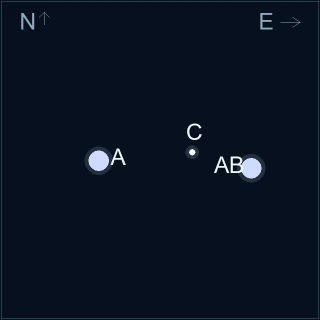
Pair AB has a measured separation of 0.2″; a telescope may be needed to split it.
The diagram uses the latest WDS measurements; north is up and east is right. Measurements may be from different years. Unconnected groups are arranged separately; close pairs may merge, and pairs without reliable geometry are omitted.
Technical details: μ Ori
| Property | Value |
|---|---|
| System identifier | WDS 06024+0939 |
| Bayer / Flamsteed designation | μ Ori |
| Constellation | Orion |
| System type | multiple star system |
| Right ascension (RA) | 06h 02m 22s" |
| Declination (Dec) | 09° 38' 50s |
| Component | AB |
| Primary magnitude | 4.30 |
| Secondary magnitude | 6.27 |
| Separation (arcseconds) | 0.2″ |
| Position angle | 27° |
| Discovery year | 1914 |
| Last observed | 2024 |
| Spectral type (primary/secondary) | A2V |
| Number of observations | 133 |
3 components are identified in WDS; this is not a count of resolved stars.
Components of μ Ori
Each row is a separate WDS component pair. Measurements may come from different years.
| Component | Primary magnitude | Secondary magnitude | Separation (arcseconds) | Position angle | Last observed |
|---|---|---|---|---|---|
| AB | 4.30 | 6.27 | 0.2″ | 27° | 2024 |
| AB,C | 4.30 | 14.00 | 18.9″ | 285° | 2008 |
Data source: Washington Double Star (WDS) Catalog. Maintained by the U.S. Naval Observatory; thanks to the WDS team.
Finder Chart for μ Ori
Where to Look for 06024+0939
See 06024+0939’s direction of rise, transit and set on a map of your surroundings.
Click the path to choose a time.
Drag to move · Double-click to unlock the map.
Key events
Direction from Your Location
| Time | 19:55 |
| Altitude | 7° |
| Azimuth | 80° |
| Latitude | 0° |
| Longitude | 0° |
When Is μ Ori Visible Throughout the Year?
| Date | Mon, 30 November 2026 |
| Astronomical observing session begins | 19:02 |
| Astronomical observing session ends | 04:26 |
| Astronomical observing duration | 9h 23m |
| Rise | 19:23 |
| Set | 07:21 |
| Elevation at transit | 80° |
| Transit time | 01:22 |
| Equatorial coordinates | RA: 06h 02m 22s", Dec: 09° 38' 50s |
| Magnitude | 4 |
| Constellation | Orion |
You can also see when μ Ori is visible throughout the year in a table with exact rise, transit, and set times for each date.
Astrometric and Physical Parameters of μ Ori
Coordinates and Visibility
| Right Ascension | 06h 02m 23s |
| Declination | 09° 38′ 50″ |
| Magnitude | 4.3 |
| Constellation | Orion |
| Elevation | 6.8° |
| Azimuth | 80.3° |