

Christmas Tree Cluster (NGC2264) Position and Visibility Tonight
Observing
- Best time
- 00:01
- Altitude
- 58°
- Direction
- North-east
- Magnitude
- 3.9
- Angular diameter
- 11.4′
At magnitude 3.9, it is visible under dark skies; binoculars help in urban areas.
NGC2264 tonight
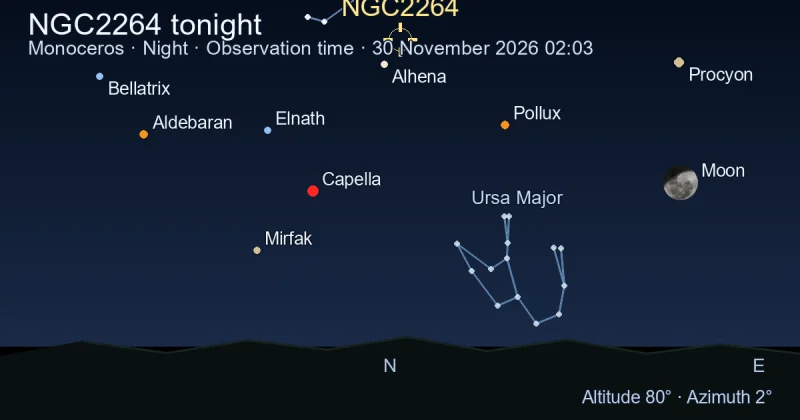
NGC2264 Visibility Tonight
Rise, Set & Night Events
| Time | Altitude | |
|---|---|---|
| Sunset | 17:50 | -33° |
| Night starts (−18°) | 19:06 | -15° |
| NGC2264 rise | 20:06 | |
Moonrise, 74.4% illuminated  | 22:59 | 43° |
| NGC2264 transit | 02:05 | 80° |
| Night ends (−18°) | 04:30 | 52° |
| Twilight end (−12°) | 04:56 | 46° |
| Civil sunrise | 05:22 | 40° |
| Sunrise | 05:46 | 34° |
| NGC2264 set | 08:04 | |
| Moonset | 11:24 | -49° |
Position throughout the night
| Time | |
| Altitude | |
| Azimuth |
Shift the map to change the time and observe NGC2264 changing position in the night sky.
NGC2264 — Image Gallery
DSS Blue

DSS Red

DSS Near-Infrared

DSS Composite Image

The images come from the Digitized Sky Survey 2 (DSS2), produced at the Space Telescope Science Institute (STScI) under contract with NASA, using data from UK Science and Technology Facilities Council (STFC), European Southern Observatory (ESO), National Geographic Society-Palomar Observatory Sky Survey (POSS II).
Special thanks to National Optical Astronomy Observatory (NOAO), Royal Observatory, Edinburgh, California Institute of Technology for their significant contributions.
Finder Chart for NGC2264
Where to Look for NGC2264
See NGC2264’s direction of rise, transit and set on a map of your surroundings.
Click the path to choose a time.
Drag to move · Double-click to unlock the map.
Key events
Direction from Your Location
| Time | 22:51 |
| Altitude | 41° |
| Azimuth | 77° |
| Latitude | 0° |
| Longitude | 0° |
When Is Christmas Tree Cluster (NGC2264) Visible Throughout the Year?
NGC2264 will remain visible until May 21, when it moves too close to the Sun and temporarily disappears from the night sky.
Visibility throughout the year
Position throughout the night
Sky Map
| Time | — |
| Altitude | — |
| Azimuth | — |
Selected date: 29 November 2026
- Night starts (−18°)
- 19:06November 29
- Rise
- 20:06November 29
- Transit
- 02:05November 30
- Night ends (−18°)
- 04:30November 30
- Set
- 08:04November 30
- Elevation at transit
- 80°
- Astronomical observing duration
- 9h 25m
- Equatorial coordinates
- RA: 06h 40m 58s", Dec: 09° 53' 43s
- Magnitude
- 4
- Constellation
- Monoceros
The graph illustrates the annual visibility pattern of NGC2264, including its daily appearances and transit times. The vertical axis shows the hours of the day and the horizontal axis spans the year. The reddish area marks when the object is above the horizon, while the white line marks its daily transit.
You can also see when NGC2264 is visible throughout the year → in a table with exact rise, transit, and set times for each date.
Astrometric and Physical Parameters of NGC2264
Coordinates and Visibility
| Right Ascension | 06h 40m 58s |
| Declination | 09° 53′ 44″ |
| Magnitude | 3.9 |
| Constellation | Monoceros |
| Elevation | 40.7° |
| Azimuth | 76.9° |
Data Credits
The deep-sky information on this page comes from the OpenNGC project developed by Matteo Verga. OpenNGC provides detailed catalog data for nebulae, galaxies, clusters and other deep-sky objects.
For details or contributions, visit the official repository: OpenNGC GitHub.