
When Is the Next Lunar Eclipse?
The next Lunar eclipse will occur on 20 February 2027.
The next Lunar eclipse on Earth is not always the next one visible from where you are. Eclipse visibility depends on your location, so the dates below answer both questions: when the next eclipse occurs anywhere in the world, and when you can see one from your selected location.
The Next Lunar Eclipse
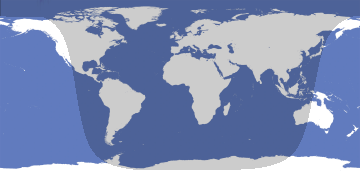
The next eclipse worldwide is a Penumbral Lunar eclipse on 20 February 2027. The card below shows the event timing, phases, visibility area and other details.
A penumbral lunar eclipse occurs when the Moon passes through Earth’s lighter outer shadow without entering the umbra. It begins at 20 February 2027, 12:14 (GMT-9), reaches maximum at 20 February 2027, 14:14, when about 96% of the lunar disk is within the penumbra, and ends at 20 February 2027, 16:14. This subtle dimming can be difficult to notice.
20 February 2027
Penumbral Lunar Eclipse
| Global | From your location | ||
|---|---|---|---|
| Penumbral | 12:14-16:14 | Not visible | |
| Partial | - | Not visible | |
| Total | - | Not visible |
The Next Lunar Eclipse Visible From Your Location
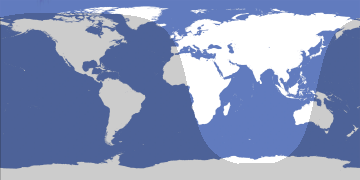
The next Lunar eclipse visible from your selected location is a Penumbral Lunar eclipse on 17 August 2027. The card below shows exactly which phases are visible from your coordinates and their local times.
A penumbral lunar eclipse occurs when the Moon passes through Earth’s lighter outer shadow without entering the umbra. It begins at 16 August 2027, 20:26 (GMT-9), reaches maximum at 16 August 2027, 22:16, when about 54% of the lunar disk is within the penumbra, and ends at 17 August 2027, 00:03. This subtle dimming can be difficult to notice.
From your selected location, the Moon is above the horizon during the eclipse from 16 August 2027, 20:26 to 17 August 2027, 00:03 (GMT-9). Only the phases within this interval are visible; clouds and local obstructions may affect your view.
- Penumbral eclipse begins: 16 August 2027, 20:26.
- Maximum eclipse: 16 August 2027, 22:16.
- Penumbral eclipse ends: 17 August 2027, 00:03.
17 August 2027
Penumbral Lunar Eclipse
| Global | From your location | ||
|---|---|---|---|
| Penumbral | 20:26-00:03 | 20:26-00:03 | |
| Partial | - | - | |
| Total | - | - |