Sky Tonight
ST
Location settings
Santa Clara, US
37.4°/-122°
GMT -9
Waxing01:24 - 03:52
⌕
Go to My SkyLog in
☾
☰
  • 🌐 EN
    ENDEESFRPT中文
  • Tonight
    • Brightest Planets and Stars Tonight
    • Milky Way Tonight
  • Solar System
    • Sun
    • Real-Time Sun Map
    • Sunspots Activity
    • Aurora Activity
    • Moon
    • Interactive Lunar Map
    • Planets
    • Mercury
    • Venus
    • Mars
    • Jupiter
    • Saturn
    • Satellite Flyovers
    • ISS
    • Close Approaches
  • Small Bodies
    • Asteroids
    • Comets
    • Recently Updated Comets
  • Stars
    • Brightest Stars
  • Meteor Showers
    • Active Meteor Showers
    • Major Meteor Showers
  • Solar Eclipses
    • Future Solar Eclipses
    • Past Solar Eclipses
  • Lunar Eclipses
    • Future Lunar Eclipses
    • Past Lunar Eclipses
  • Deep Sky Objects
    • Seasonal Nebulae
    • Messier Objects
    • Nebulae
    • Star Clusters
    • Galaxies
  • Double Stars
    • Naked-eye
    • Binocular
    • Physical pairs
    • Color-contrasting
    • Triple systems
    • Multiple systems
  • Constellations
    • Visible Tonight
    • Seasonal
    • Ecliptic
    • All 88 Constellations
  • Maps
    • Mars Map
    • Mercury Map
    • Earth
    • Cloud Cover Map
  • Contact Us
    • Feedback

Observation Settings

Or select it on the map:
This Earth map lets you select the observer’s location used to calculate the bearing and elevation of celestial objects. The selected point determines how the sky, rise and set times, and object positions are shown.
Your location: Santa Clara, United States
Timezone:
Latitude:
37.3541
Longitude:
-121.955

Sky Tonight

Whether you use your eyes, binoculars or a telescope, the night sky offers endless discoveries. Happy stargazing!

Sky Map

Celestial bearing and elevation at 01:24
This interactive sky map shows what is visible now from your location, including the Moon, planets, bright stars, meteor activity and satellite flyovers. Move the map horizontally to follow the sky through the night.

What’s Visible in the Sky Tonight — September 14

Sun

From your location, the Sun sets at 17:17 and nautical twilight ends at 18:15. The sky remains dark enough for stargazing until morning twilight begins at 03:52.

Moon

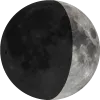
The Moon is in the Waxing Crescent phase and is about 12% illuminated. It rises at 07:32 and sets at 18:26.

Planets

Venus: Visible from sunset until late evening. Venus is brighter than any star above the horizon, shining about 90 times brighter than Capella, the brightest star currently visible. Jupiter: Visible from early morning until sunrise. Saturn: Visible from late evening until sunrise. Mars: Visible from early morning until sunrise.

Stars

Notable stars include Capella, Rigel, and Procyon, among the brightest stars currently visible.

Deep-Sky Objects

Notable deep-sky objects visible tonight include Beehive, Andromeda Galaxy (M31), and Orion Nebula (M42). They can be observed with binoculars or a small telescope.

Highlights of Tonight’s Sky

Here is a brief selection of celestial objects and events you can explore tonight:

Solar System Objects
Sun

Not visible tonight

Sun
↗ 04:50 ↘ 17:15 ↑ -12°
☼ -26.7 ✣ 32'
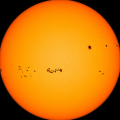
170 active sunspot regions. Largest: 4529 (Bxo, 10 MSH). No significant flares detected today.
More about Sun

Moon

Waxing Crescent (12% illuminated)

Moon
↗ 07:31 ↘ 18:23 ↑ -52°
☼ -7.5 ✣ 31'
The Full Moon occurs on 26 September 2026 at 07:24 in Pisces.
The New Moon follows on 10 October 2026 at 06:23 in Virgo.
More about Moon

Planets

See which planets are currently visible and check their rise and set times.
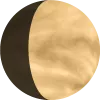
Venus

Visible from sunset until late evening

Venus
↗ 08:23 ↘ 18:34 ↑ 9°
☼ -4.8 ✣ 36.7"
Venus is currently in the constellation Virgo. It is now fading as it moves toward conjunction and will reach its next greatest elongation around January 4.
More about Venus

Jupiter

Visible from early morning until sunrise

Jupiter
↗ 01:58 ↘ 15:40 ↑ 22°
☼ -1.8 ✣ 32.4"
Jupiter is currently in the constellation Cancer. It is now brightening after conjunction and will reach its next opposition around February 11.
More about Jupiter

Saturn

Visible from late evening until sunrise

Saturn
↗ 18:18 ↘ 06:32 ↑ 53°
☼ 0.4 ✣ 19.6"
Saturn is currently in the constellation Cetus. It is now brightening after conjunction and will reach its next opposition around October 5.
More about Saturn

Mars

Visible from early morning until sunrise

Mars
↗ 23:55 ↘ 14:21 ↑ 45°
☼ 1.2 ✣ 5.3"
Mars is currently in the constellation Gemini. It is now brightening after conjunction and will reach its next opposition around February 20.
More about Mars
For the complete list and upcoming visibility dates, open the Planets Tonight page.

Satellite Flyovers

A short list of the brightest upcoming satellite flyovers.
No bright satellite flyovers are expected in the next hour.
For the complete schedule, open the Satellites page.

Brightest Stars

Five of the brightest stars currently visible in the night sky.

Capella

Star
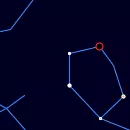
Capella
↗ 01:24 ↘ 14:17 ↑ 76°
☼ 0.1 ✣ -
Capella, the sixth brightest star, is a yellow giant located in the constellation Auriga. Its brightness and close proximity to the celestial north pole make it easily identifiable.
More about Capella

Rigel

Star

Rigel
↗ 01:24 ↘ 10:21 ↑ 43°
☼ 0.2 ✣ -
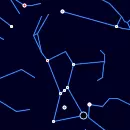
Rigel, the seventh brightest star, is a blue supergiant in the constellation Orion. It is one of the most massive and luminous stars visible to the naked eye.
More about Rigel

Procyon

Star

Procyon
↗ 01:24 ↘ 13:27 ↑ 34°
☼ 0.4 ✣ -
Procyon, the eighth brightest star, is a binary system in the constellation Canis Minor. Its name means 'before the dog' as it rises just before Sirius, the 'Dog Star'.
More about Procyon

Betelgeuse

Star

Betelgeuse
↗ 01:24 ↘ 11:50 ↑ 53°
☼ 0.5 ✣ -
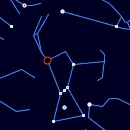
Betelgeuse, the tenth brightest star, is a red supergiant in the constellation Orion. It is one of the largest known stars and exhibits noticeable variability in brightness.
More about Betelgeuse

Aldebaran

Star

Aldebaran
↗ 01:24 ↘ 11:00 ↑ 69°
☼ 0.9 ✣ -
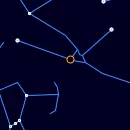
Aldebaran is an orange giant star situated in the constellation Taurus. Its name means 'the follower' as it appears to follow the Pleiades star cluster across the sky.
More about Aldebaran
Explore the complete list of the brightest stars.

Nebulae

Discover the brightest nebulae currently visible in the night sky.

M44

Open Cluster
M44
↗ 01:24 ↘ 15:15 ↑ 31°
☼ 3.1 ✣ 2'
The Beehive Cluster, an open star cluster containing over 1,000 stars, located approximately 577 light-years away in the constellation Cancer.
More about M44

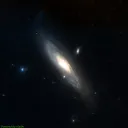
Andromeda Galaxy (M31)

Galaxy

Andromeda Galaxy (M31)
↗ 01:24 ↘ 09:03 ↑ 76°
☼ 3.4 ✣ 3'
The Andromeda Galaxy, the nearest spiral galaxy to the Milky Way, containing over a trillion stars, located approximately 2.537 million light-years away.
More about Andromeda Galaxy (M31)

Orion Nebula (M42)

Star cluster + Nebula
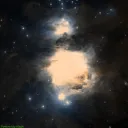
Orion Nebula (M42)
↗ 01:24 ↘ 10:51 ↑ 44°
☼ 4 ✣ 2'
The Orion Nebula, a bright emission nebula and star-forming region, containing over 700 stars, located approximately 1,344 light-years away in the constellation Orion.
More about Orion Nebula (M42)

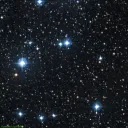
M39

Open Cluster

M39
↗ 01:24 ↘ 07:02 ↑ 43°
☼ 4.6 ✣ 19.50"
An open star cluster containing approximately 30 stars, located approximately 800 light-years away in the constellation Cygnus.
More about M39

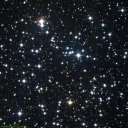
M35

Open Cluster

M35
↗ 01:24 ↘ 13:02 ↑ 63°
☼ 5.1 ✣ 24.00"
An open star cluster containing over 1200 stars, located approximately 2,800 light-years away in the constellation Gemini.
More about M35
For a complete list with locations, brightness and photos, open the Nebulae page.